There's something about a bank holiday that makes families reach for the road atlas (or Google Maps, but you know what we mean). Three days off, a weather forecast that's almost promising, and the vague ambition of getting somewhere interesting before Monday. It sounds straightforward. Then you factor in the kids, the M5, and a toddler who last did a long drive in 2024, and suddenly you're planning a military operation.
The good news is that bank holiday road trips with kids genuinely can be brilliant. The key is a bit of planning up front, realistic expectations for the journey itself, and having the right kit in the car. Here's what we've learned from thousands of UK families who do this regularly.
Plan Your Route and Timing Around the Traffic
Bank holidays are notoriously bad for traffic, particularly on Friday afternoons and Saturday mornings heading west or south-west. The AA and traffic data consistently show the worst pinch points: the M5 towards Devon and Cornwall, the A303 to Stonehenge, the M6 northbound, and anything heading to the Lake District on a Friday.
The two strategies that actually work are leaving very early (before 7am, ideally before 6am) or waiting until the evening rush has cleared. Families who leave at 5:30am often describe it as "magical" because the roads are empty and small children are still drowsy for the first hour. Early starts are genuinely one of the best hacks for bank holiday travel.
Plan a stop every 90 minutes to 2 hours. Not just for fuel, but for kids to run around. A 10-minute leg stretch at a service station makes the next 90 minutes dramatically easier. Build the stops into your estimate rather than treating them as delays.
What to Pack for the Journey
The packing split matters as much as the packing list. Think of it in two zones: what goes in the boot (you won't need it until you arrive) and what stays in the cabin (you'll need it within the next 90 minutes).
In the cabin, within reach of the children:
- Tablet or device, fully charged, with downloads queued up
- Headphones (child-sized, so they don't share your sanity)
- Snacks in individual portions, not one big bag everyone fights over
- Drinks in sealed, non-spill bottles
- A small activity book or colouring set per child
- Wet wipes (always more than you think you need)
- A spare change of clothes per child, in a small bag
- Any comfort toys or blankets
In the boot:
- Main luggage
- Beach or outdoor kit
- Pushchair if needed
- Food shopping or supplies for the week
- Anything that doesn't need to come out until you arrive
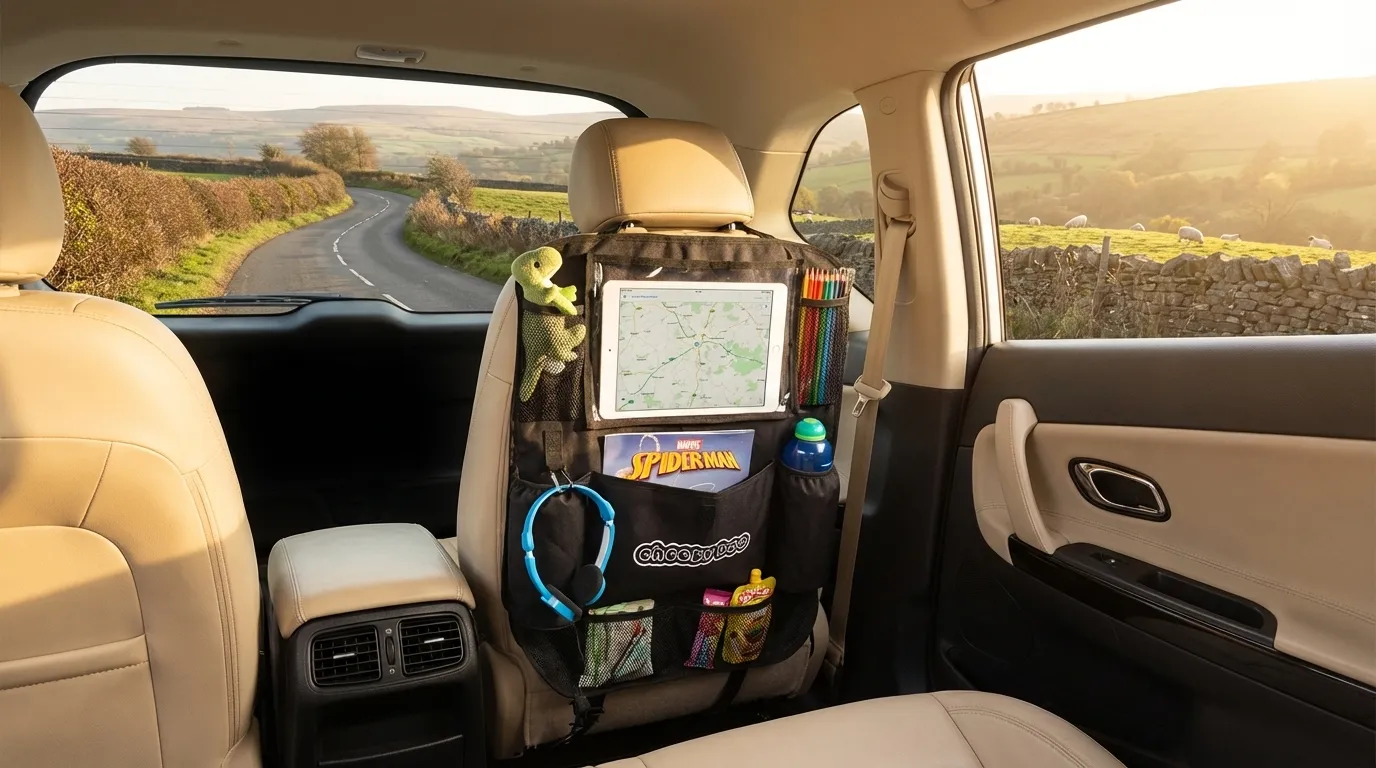
💡 The cabin chaos problem: The challenge isn't having the right items in the car. It's having them accessible without turning the back seat into a tip by junction 15. A back-seat organiser solves this completely. The CheekyBoo Car Seat Organiser hangs off the front seat headrest and gives children their own organised space: a pocket for the tablet, insulated holders for drinks, and smaller pockets for snacks and bits. Everything in one place, everything within reach. No rummaging in bags, no items rolling under seats.
Keeping Kids Entertained on the Road
Every family has its own approach to in-car entertainment, and none of them are wrong. Here's what tends to work across different ages.
For toddlers (1-3), keep things rotating. Ten minutes of a favourite show, then a snack, then a song, then a sticker book. Monotony sets them off faster than anything. Download shows before you go because motorway Wi-Fi is not reliable.
For the 4-7 age group, audiobooks and podcasts designed for kids work brilliantly. Paddington Bear audio stories, Horrible Histories podcasts, and the Roald Dahl audio collection are perennial favourites. Mix these with road-trip games like spotting red cars or counting bridges.
For older kids (8 and up), give them a role. Let them navigate on a paper map, or task them with taking photos of interesting things you pass. Children who feel involved in the journey are far less likely to ask if you're nearly there yet.
Why the Right Car Kit Makes the Difference
The difference between a smooth bank holiday drive and a stressful one often comes down to tiny practical details. The snack that fell under the seat and caused a 10-minute meltdown. The tablet that needed charging but the cable was in the boot. The drink that spilled because the bottle wasn't secure. None of these things is a big deal on its own, but they stack up.
Getting the back seat organised before you set off removes a significant chunk of these friction points. When everything has a place, children are more settled, parents reach the back seat less often, and the whole journey runs more smoothly.
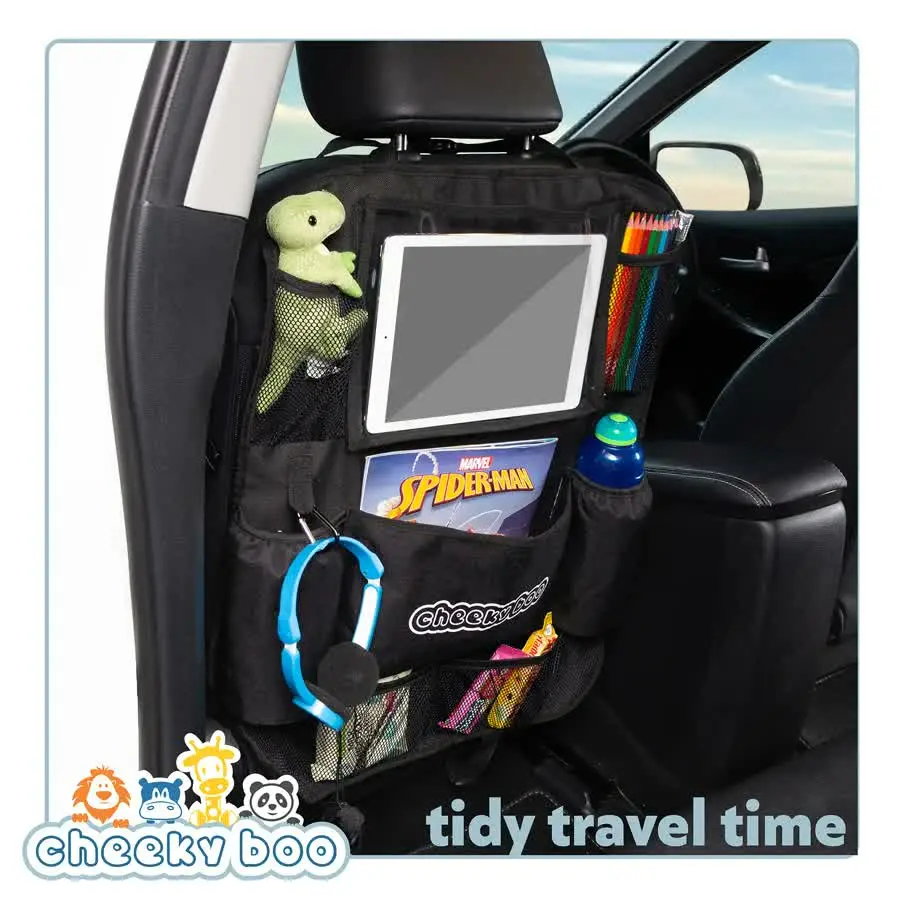
CheekyBoo Car Seat Organiser
8 pockets including a 10.1" tablet pocket and insulated drinks holders. Wipe-clean material. Fits all car seats. Over 822 reviews from UK parents, rated 4.3 stars. £16.99 with free Prime delivery.
Shop on Amazon UK →